
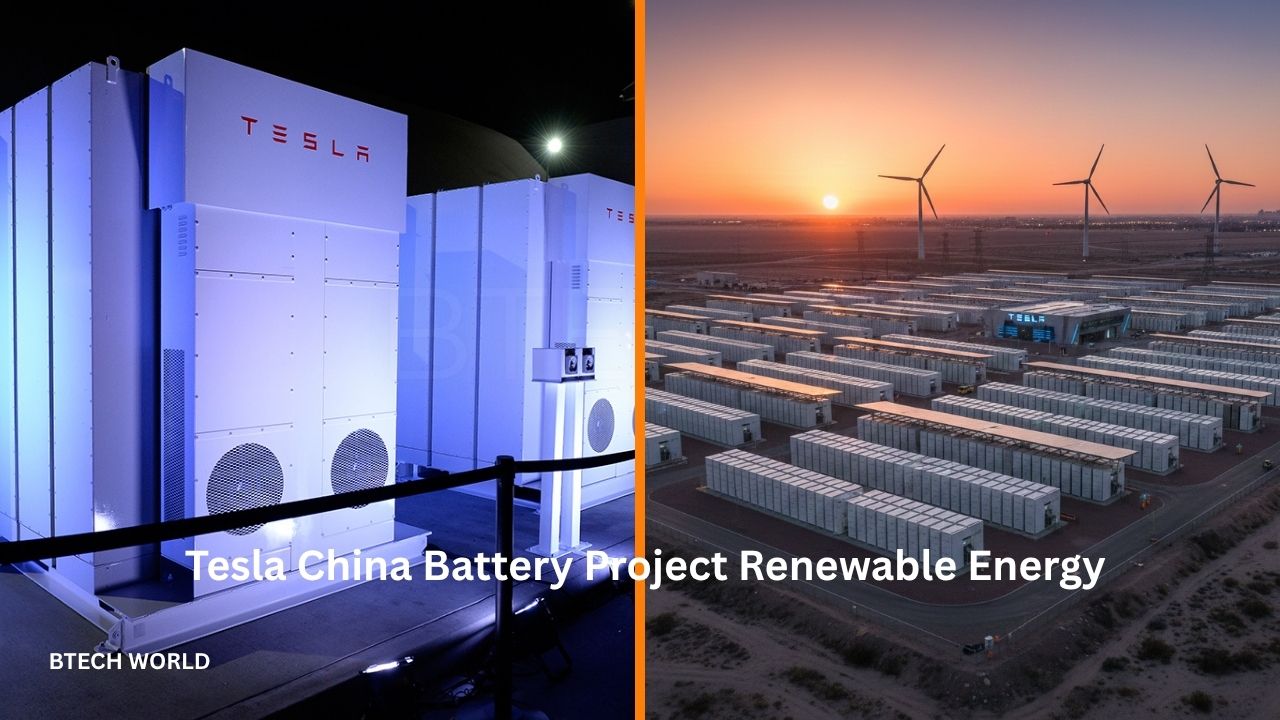
How Tesla China Battery Project Renewable Energy Is Transforming Grid Storage and Clean Power

The Tesla China Battery Project Renewable Energy is an important development in large-scale energy storage and renewable power. Tesla opened its Shanghai Megafactory in February 2025 to manufacture Megapack systems, which store electricity for utilities and large energy projects. The facility represents Tesla’s expansion beyond electric vehicle manufacturing and into the infrastructure needed to support cleaner, more reliable electricity grids.
Renewable energy sources such as solar and wind can generate substantial amounts of electricity, but their output changes with weather and time of day. Battery storage helps address this challenge by saving surplus electricity and releasing it when demand rises or renewable generation falls. Tesla’s Shanghai project supports this wider transition by increasing the manufacturing capacity available for utility-scale storage systems.
What Is the Tesla China Battery Project?
Tesla’s China battery project centers on the Shanghai Megafactory in the Lin-gang Special Area. Unlike Tesla’s electric vehicle factory, which produces cars, this facility manufactures Megapack energy-storage systems for large-scale electricity applications.
Construction began in May 2024, and the factory produced its first Megapack in February 2025. According to Shanghai’s municipal government, the facility covers approximately 200,000 square meters and represented an investment of around 1.45 billion yuan. Its planned annual production capacity was announced at 10,000 Megapack units.
The project is significant because it is Tesla’s first Megapack manufacturing facility outside the United States. Producing storage equipment in China can help the company serve international markets and expand its industrial energy business. However, the factory manufactures batteries; it does not itself function as a single giant battery supplying electricity to the grid.
Understanding Tesla Megapack Technology
Megapack is Tesla’s utility-scale battery system, designed to store and deliver electricity for power networks, renewable energy projects, and industrial users. Each unit integrates battery modules with power conversion and thermal management equipment, helping simplify installation compared with assembling every component separately.
Tesla’s Shanghai Megafactory was announced with the capacity to produce approximately 10,000 units annually, equivalent to roughly 40 gigawatt-hours of storage capacity at the planned production rate. This figure describes the potential storage capacity represented by a year’s output, not the energy stored at the factory or the amount of electricity it generates. Actual production can vary with demand, equipment availability, and supply-chain conditions.
Megapack systems can be installed in groups to create larger storage projects. Utilities can then use these installations to shift electricity across different times of day, support grid operations, and provide backup capacity when the power system needs additional flexibility.
How Battery Storage Supports Renewable Energy
Solar and wind power are essential to reducing dependence on fossil fuels, but neither produces electricity at a constant rate. Solar panels generate most of their power during daylight, while wind turbines depend on changing wind conditions. Electricity demand, meanwhile, may peak at times when renewable generation is limited.
Large battery systems help bridge this gap. When renewable projects produce more electricity than the grid immediately needs, batteries can store part of the surplus. Later, when solar output declines or demand increases, the stored energy can be returned to the network.
This process is often called energy shifting. It helps grid operators make better use of renewable electricity that might otherwise be curtailed because of transmission constraints or temporary oversupply. Battery storage cannot solve every challenge associated with renewable energy, but it provides a flexible tool for balancing supply and demand over shorter periods.
The Role of Tesla’s Shanghai Megafactory in Clean Power
A renewable energy transition requires more than installing solar panels and wind turbines. It also needs transmission lines, grid upgrades, control systems, and storage equipment capable of responding to changing conditions. Tesla’s Shanghai Megafactory contributes to this wider infrastructure by manufacturing large battery systems for utility-scale projects.
Higher manufacturing capacity can help make storage equipment available to more developers and electricity providers. The Shanghai facility also gives Tesla another production base from which to serve international customers. In July 2025, Shanghai’s municipal government reported that the factory had produced its 1,000th Megapack, which was destined for Europe.
The project’s wider contribution depends on how many systems are produced, where they are installed, and how effectively operators use them. Manufacturing capacity creates an opportunity for wider deployment, but the environmental benefits ultimately depend on real-world operation and the electricity sources being supported.
Improving Grid Stability and Reliability
Electricity grids must balance supply and demand continuously. Sudden changes in consumption or generation can affect grid frequency and voltage, potentially creating reliability problems if operators cannot respond quickly enough.
Battery storage systems can react rapidly to control signals. Depending on their configuration and grid connection, they can supply electricity, absorb excess power, and provide services that help stabilize the network. Tesla describes Megapack as a system that can support frequency regulation, energy shifting, capacity reserves, and other grid services.
These functions can be valuable as electricity systems add more variable renewable generation. Batteries may also help reduce pressure during periods of high demand. Nevertheless, they do not replace every conventional power plant or grid upgrade. Their effectiveness depends on the system’s design, the available stored energy, and the duration of the grid emergency.
Supporting Solar Energy Projects
Solar power is a natural partner for large-scale battery storage. Solar installations often produce their strongest output around midday, while electricity demand can remain high into the evening. Without sufficient flexibility, some solar generation may be wasted when supply exceeds demand or network capacity.
A battery connected to a solar farm can store surplus daytime electricity and release it later. This makes the solar project more useful across a broader range of hours and may improve the value of the energy it supplies. Utilities can also combine storage with forecasts and software to schedule charging and discharging around expected generation and demand.
Tesla’s Megapack systems are designed for these types of utility-scale applications. The Shanghai factory could support the wider solar-storage market by expanding the supply of equipment. However, a project’s performance depends on its location, battery size, connection capacity, operating strategy, and local electricity-market rules.
Helping Wind Power Become More Flexible
Wind farms can generate large amounts of electricity when wind conditions are favorable, but output can fluctuate over time. These changes may create difficulties for grid operators, particularly when wind generation represents a large share of the electricity supply.
Battery storage can absorb some excess electricity during periods of strong wind and deliver it later when generation drops. This flexibility can help smooth short-term variations and reduce the need to curtail wind generation when the grid cannot immediately use all available output.
The technology has limits. Batteries can shift energy across hours, but they cannot independently provide unlimited electricity through several days of low wind. Longer periods of low renewable output may require a combination of expanded transmission, different renewable sources, demand management, long-duration storage, and other dependable resources.
The Tesla China Battery Project is therefore best understood as one component of a broader energy system, rather than a complete solution to renewable power variability.
Economic Opportunities and Industrial Growth
The Shanghai Megafactory creates opportunities across manufacturing, logistics, engineering, installation, and energy services. Producing large battery systems requires coordinated supply chains and specialized processes, while completed projects require skilled teams to connect, monitor, and maintain the equipment.
The factory may also strengthen Tesla’s position in the global stationary-storage market. As utilities and renewable developers seek ways to manage variable electricity supply, demand for grid-scale storage can create new business opportunities for battery manufacturers and software providers.
For customers, the economics depend on more than the purchase price of a battery. Project developers must consider installation, financing, maintenance, efficiency losses, replacement costs, electricity-market revenues, and the value of grid services. Storage is most useful when its ability to shift energy or improve reliability justifies these costs.
Environmental Benefits and Important Limitations
Battery storage can help reduce emissions when it stores renewable electricity that would otherwise go unused and later replaces electricity from more carbon-intensive sources. It may also reduce reliance on fossil-fuel peaking plants in suitable locations. Tesla presents Megapack as part of its approach to building more stable grids and integrating additional renewable energy.
However, batteries are not automatically emissions-free. Their environmental impact includes the mining and processing of raw materials, manufacturing energy, transportation, operational losses, and end-of-life management. The climate benefit depends partly on the electricity used to charge them and the generation they displace when discharging.
Responsible recycling and battery-material recovery will become increasingly important as the global storage fleet grows. Grid planners must also account for fire safety, suitable site design, emergency procedures, and the effects of large installations on local infrastructure. Careful project planning helps ensure that the benefits of storage outweigh its costs and risks.
What the Project Means for the Global Energy Market
Tesla’s Shanghai facility gives the company another manufacturing base for its stationary-storage products and expands its ability to supply customers beyond the United States. Its production launch and subsequent shipments demonstrate how battery manufacturing is becoming a distinct part of the clean-energy industry rather than simply an extension of electric vehicle production.
The project may also encourage greater attention to storage as countries modernize their electricity systems. As solar and wind capacity expands, power providers need equipment that can respond to changing conditions and make better use of existing generation assets.
Still, the factory’s impact should be measured through actual output, completed installations, system performance, costs, and emissions reductions—not manufacturing targets alone. Other manufacturers, grid operators, governments, and energy developers will also shape the future of large-scale storage.
The Future of Tesla China Battery Project Renewable Energy
The future importance of the project will depend on how quickly Tesla can manufacture Megapack systems, how effectively customers deploy them, and whether storage costs continue to improve. Growing electricity demand from industry, data centers, and electrification may create additional reasons to invest in grid flexibility.
Battery technology is also evolving. Improvements in energy density, durability, safety, manufacturing efficiency, and recycling could make future storage systems more practical for a wider range of applications. Software will remain important because even a large battery is only as useful as the controls and operating strategy that determine when it charges and discharges.
Tesla’s Shanghai Megafactory is part of this changing landscape. It expands the supply of utility-scale storage equipment, while the wider transition to clean power will still require investment in renewable generation, transmission, grid modernization, and responsible battery management.
Conclusion
The Tesla China Battery Project represents a major step in Tesla’s expansion into large-scale energy storage. Its Shanghai Megafactory manufactures Megapack systems designed to store electricity, support grid stability, and help integrate solar and wind power. With an announced annual production target of around 10,000 units, equivalent to roughly 40 GWh of storage capacity, the facility has the potential to contribute significantly to the global battery-storage supply chain.
However, manufacturing capacity alone does not guarantee cleaner electricity or a more reliable grid. Those outcomes depend on where batteries are installed, how they are charged and operated, and how responsibly their materials are sourced and recycled. Combined with renewable generation and modern grid infrastructure, large-scale storage can play an important role in building a more flexible and sustainable energy system.
Frequently Asked Questions
Q1. What is the Tesla China Battery Project?
It is Tesla’s Shanghai Megafactory, located in the Lin-gang Special Area, which manufactures Megapack battery systems for utility-scale energy storage projects.
Q2. When did Tesla’s Shanghai Megafactory begin production?
The factory began production on February 11, 2025, when its first Megapack unit came off the production line.
Q3. How much battery storage capacity can the factory produce annually?
The announced production plan was up to 10,000 Megapack units per year, representing approximately 40 GWh of storage capacity at that production level. Actual output may vary.
Q4. How do Tesla Megapacks support renewable energy?
They can store surplus electricity from sources such as solar and wind, then release it when generation falls or demand rises. They can also provide certain grid-support services.
Q5. Does the Tesla China Battery Project eliminate the need for fossil fuels?
No. Battery storage can reduce reliance on fossil-fuel generation in suitable circumstances, but it cannot replace every power source or solve all long-duration energy-supply challenges. A reliable, low-emission grid requires a mix of technologies and infrastructure.
Explore More BTECH WORLD