What Is a JWT Token and How Does It Work?

A JWT token is a widely used method for securely sharing information between applications, websites, and servers. JWT stands for JSON Web Token, a compact format that carries information about a user or another subject. Developers commonly use JWTs in web applications, mobile apps, and APIs to support authentication and authorization. Understanding what a JWT token is and how it works helps developers build applications that manage user access more effectively.
JWT tokens are popular because they can carry important information in a structured format and can be verified using digital signatures. Instead of requiring a server to look up a traditional session record for every request, an application can validate a properly signed token and check its claims. However, JWTs are not automatically secure simply because they use a standard format. Their safety depends on how developers create, store, transmit, validate, and expire them.
What Is a JWT Token?
A JSON Web Token is a compact, URL-safe way to represent a set of claims, which are statements about a user, application, or other entity. These claims might include a user identifier, an issuer, an expiration time, or permissions. JWTs are commonly used to communicate identity and access information between a client and a server. They are defined by an open standard, making them suitable for applications built with different programming languages and technology platforms.
A JWT often appears as three groups of characters separated by periods. These groups represent the header, payload, and signature in a typical signed JWT. The header describes the token type and signing algorithm, while the payload contains claims. The signature helps the receiving application verify that the token has not been altered. Importantly, a signed JWT is not necessarily encrypted. Anyone who obtains it may be able to read its payload, so sensitive information should not be included without appropriate encryption.
How Does a JWT Token Work?
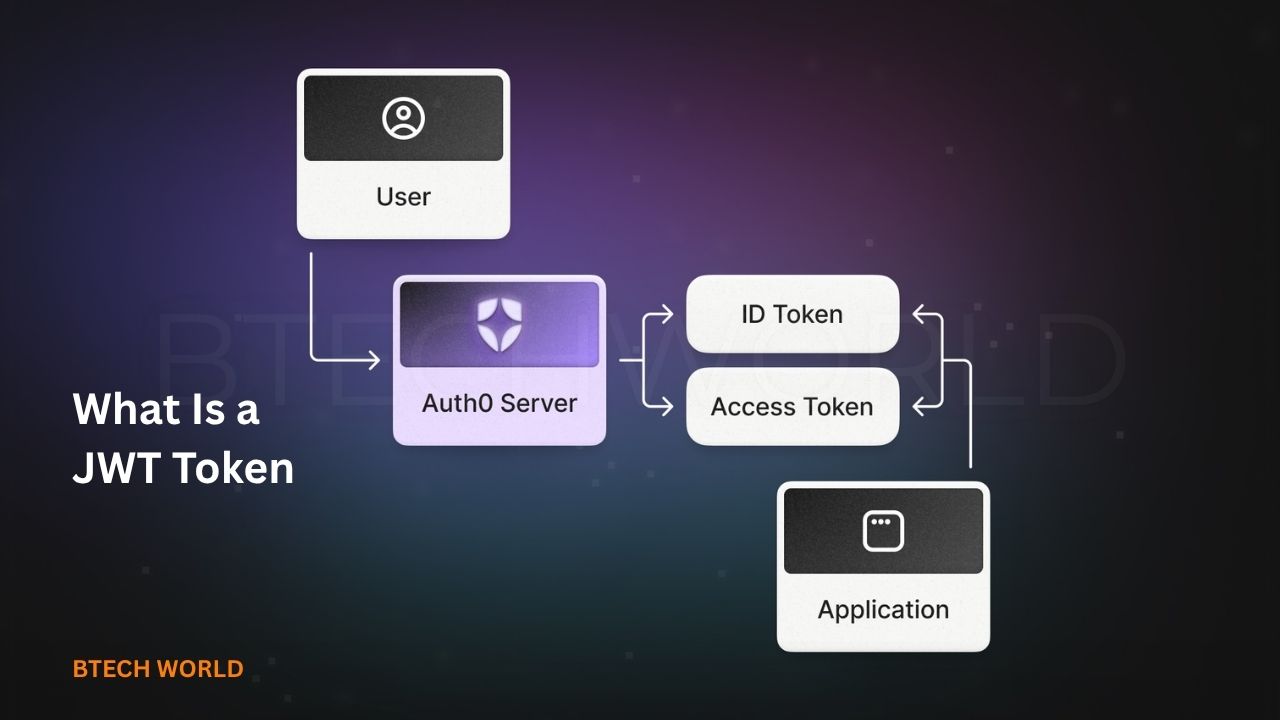
A typical JWT authentication process begins when a user signs in to an application using valid credentials. The authentication server checks those credentials and, if authentication succeeds, issues a token containing relevant claims. The application sends that token to the client, which may store it according to the application’s security design. When the user requests a protected resource, the client sends the token to the relevant server, commonly through an HTTP authorization header.
The server then validates the token before deciding whether to grant access. It verifies the signature or authenticated encryption, checks relevant claims such as the expiration time, and confirms that the token was issued by a trusted source for the intended recipient. If the token passes validation and the requested action is permitted, the server processes the request. If the token is invalid, expired, or unsuitable for the resource, the server should reject it. A valid token does not automatically authorize every action.
Understanding the Three Parts of a JWT
A typical signed JWT, commonly represented as a JSON Web Signature (JWS), contains three parts: a header, a payload, and a signature. Each part serves a different purpose. They are encoded using Base64url encoding and joined with periods to form a compact string. The encoded sections can look complicated, but the structure is straightforward once you understand what each component contains and how the server uses it.
Consider this simplified structure:
xxxxx.yyyyy.zzzzz
The first section represents the header, the second represents the payload, and the third represents the signature. The actual values are longer and depend on the claims and signing algorithm. A JWT can also use other standardized forms, including encrypted JWTs (JWE), which have a different structure. Developers should identify the token format they are working with rather than assuming every token follows the same three-part structure.
JWT Header
The header contains metadata about the token. In a common signed JWT, it identifies the token type and the algorithm used to create the signature. For example, a simplified header might contain "alg": "HS256" and "typ": "JWT". HS256 uses HMAC with SHA-256, which relies on a shared secret. Other supported algorithms use different cryptographic approaches, including public and private keys.
The header helps the receiving system understand how the token is intended to be processed. However, the header itself is not trustworthy until the token has been properly validated. An application must not blindly accept whatever algorithm the token specifies. Instead, it should configure an appropriate allowlist of algorithms and follow the security requirements of its authentication system. Incorrect algorithm handling can introduce serious vulnerabilities.
JWT Payload
The payload contains claims, which are pieces of information about the token’s subject or intended use. A payload may include the user’s identifier, the token issuer, the intended audience, and timestamps that control when the token becomes valid or expires. Standard registered claims include sub for the subject, iss for the issuer, aud for the audience, iat for the issued-at time, and exp for the expiration time.
Developers can also include custom claims when their application requires additional information, such as a role or tenant identifier. However, the payload of a typical signed JWT is readable by anyone who obtains the token. Base64url encoding is not encryption. Avoid including passwords, private keys, payment details, or other confidential information in an unencrypted payload. Also, treat claims as untrusted until the token’s authenticity and relevant requirements have been verified.
JWT Signature
The signature is used to detect unauthorized changes to a signed JWT. Depending on the chosen algorithm, it may be generated using a shared secret or a private key. When the server receives the token, it verifies the signature using the appropriate secret or public key. If someone modifies the header or payload, the signature should no longer validate, assuming the cryptographic implementation and key management are correct.
A valid signature does not prove that every claim is appropriate or that the token should be accepted for every application. The server must also check the issuer, audience, expiration, and other requirements relevant to its use case. For example, a token issued for one API should not automatically be accepted by another API. Signature verification is an essential security step, but it is only one part of complete token validation.
What Is a JWT Token Used For?
JWTs are commonly used in authentication systems, where an application needs to recognize a user after the initial sign-in. After successful authentication, a server may issue a token that the client presents on subsequent requests. The server can validate the token to identify the subject without necessarily maintaining a traditional session record for every request. This can simplify some distributed application designs, although the system still needs secure token issuance, expiration, and access-control rules.
JWTs are also used in API authorization and information exchange between trusted systems. An API may inspect verified claims to determine which user or service is making a request and whether that identity has the required permissions. In some systems, tokens are used between services to represent a particular audience and set of privileges. JWT is a token format, however, not a complete authentication protocol. Secure applications still need to define how tokens are issued, transported, validated, and used.
User Authentication
Authentication determines who or what is attempting to access an application. In a JWT-based login system, the authentication server first verifies the user’s credentials or another accepted authentication method. It may then issue an access token that represents the authenticated subject. The client includes the token in later requests, allowing the server to validate the token and associate the request with that subject.
JWTs do not replace the initial authentication process. A server must still verify the user through an appropriate method, such as a password combined with multifactor authentication or a trusted identity provider. Developers should also consider what happens when an account is disabled or a user’s credentials are compromised. A token may remain usable until it expires unless the system implements additional controls, such as revocation, token introspection, or short expiration periods.
API Authorization
Authorization determines what an authenticated user or service is allowed to do. A JWT may contain claims that help an API make authorization decisions, such as scopes, roles, or permissions. For example, an API might allow a user with a verified read permission to view a resource while requiring a separate write permission to update it. The application must validate the token first and then apply its own access-control rules.
Developers should follow the principle of least privilege when designing JWT claims. A token should grant only the access needed for its intended purpose, and its audience should identify the service that is supposed to accept it. Avoid treating a role or permission claim as reliable before validating the token. For sensitive operations, the application may also need to check current account status or permissions rather than relying entirely on claims issued earlier.
JWT Token Example Explained
A JWT usually looks like a long string containing three encoded sections separated by periods. In a simplified example, the payload might contain a subject identifier and an expiration timestamp. The header might specify a signing algorithm, and the signature would be generated using the appropriate cryptographic key. The visible characters are not the claims themselves; they are encoded representations that a JWT library can parse.
A conceptual payload might look like this:
{
  "sub": "user123",
  "iss": "https://auth.example.com",
  "aud": "https://api.example.com",
  "exp": 1790000000
}
This example describes a subject, an issuer, an intended audience, and an expiration time. The values are illustrative, not a real access token. The expiration value represents a Unix timestamp and must be interpreted correctly by the validating system. A server should verify that the issuer is trusted, the audience matches the API, and the token has not expired. It must also validate the signature or encryption and any other required claims before accepting the token.
JWT vs. Session-Based Authentication
JWT authentication and session-based authentication are two different approaches to managing access after a user signs in. In traditional session-based authentication, the server typically creates a session record and sends the client a session identifier, often through a cookie. The server uses that identifier to retrieve the session’s state. With JWT authentication, a server can validate token claims and a cryptographic signature without necessarily looking up a session record on every request.
| Feature | JWT-based approach | Session-based approach |
|---|---|---|
| Stored state | Claims can be carried in the token | Session state is typically stored server-side |
| Request validation | Verify token and required claims | Look up and validate the session |
| Revocation | May require additional controls | Often straightforward by invalidating the session |
| Scaling | Can simplify validation across services | May require shared session storage |
| Token size | May grow as claims are added | Session identifiers are often smaller |
| Security | Depends on token handling and validation | Depends on session and cookie security |
Neither approach is always better. JWTs can be useful in distributed systems where several services need to validate tokens, while server-side sessions can make immediate logout and session invalidation simpler. JWT systems may still require a database or revocation mechanism for certain security requirements. The best choice depends on the application’s architecture, threat model, and operational needs rather than a general claim that one approach is always more secure.
Benefits of Using JWT Tokens
One advantage of JWTs is their compact and standardized structure. They can carry claims in a format supported by many programming languages and frameworks, making integration between different services easier. When tokens are correctly signed and validated, a receiving service can verify their integrity without contacting the issuing server for every request. This can help reduce dependencies and support distributed applications, although key distribution and trust configuration still require careful management.
JWTs can also help applications communicate identity and permissions in a consistent way. Standard claims provide a common vocabulary for information such as the issuer, subject, audience, and expiration. Developers can add carefully designed custom claims where needed. However, adding more claims increases token size and may expose information to anyone who obtains an unencrypted token. These benefits are most useful when JWTs are applied to a well-designed authentication system rather than treated as a complete security solution.
JWT Security Risks and Limitations
A JWT is a bearer credential in many common authentication designs, meaning that anyone who obtains it may be able to use it until it expires or is otherwise invalidated. If a token is stolen through malware, a compromised device, insecure storage, or an application vulnerability, an attacker may be able to make requests as the token’s subject. HTTPS helps protect tokens in transit, but it does not prevent every form of theft or misuse.
Another limitation is that a self-contained token can become difficult to invalidate immediately once it has been issued. If the token remains cryptographically valid, a server may accept it until its expiration unless the application uses additional checks. JWTs also introduce risks when applications trust unverified claims, accept unsafe algorithms, or fail to check the intended audience. Developers must consider the entire lifecycle of the token, from issuance and storage to validation, expiration, and revocation.
Token Theft and Replay Attacks
Token theft occurs when an unauthorized person obtains a valid token. A replay attack occurs when a captured token is reused to make requests. Because many access tokens are bearer tokens, possession may be enough to use them; the attacker does not necessarily need the user’s password. Applications should therefore protect tokens as carefully as they protect other credentials and avoid placing them in URLs, where they may be recorded in browser history, server logs, or referrer data.
To reduce these risks, use HTTPS for all token transmission, minimize token lifetime, and avoid logging full tokens. Choose storage appropriate to the application and threat model. For browser applications, secure, HttpOnly cookies can reduce direct access by JavaScript, but cookie-based designs need appropriate CSRF protections. Tokens stored in browser-accessible storage can be exposed by cross-site scripting. No storage option eliminates every risk, so developers should also use content security controls and other standard web defenses.
Weak Secret Keys and Signature Validation
A signed JWT is only as trustworthy as the way its signature is generated and validated. With a symmetric algorithm such as HS256, anyone who possesses the shared signing secret can potentially create valid tokens. A weak or exposed secret may allow an attacker to forge claims. With asymmetric signing, the private key must remain protected, while verifying services can use the corresponding public key to validate signatures.
Use a reputable JWT library and follow its secure configuration guidance. Store secrets and private keys in an appropriate secrets manager or secure key-management system, restrict access, and rotate keys according to a planned process. Configure accepted algorithms explicitly rather than trusting the token header to choose any algorithm. Reject malformed tokens, validate required claims, and never assume that decoding a JWT is equivalent to verifying it.
Expiration and Token Revocation
JWTs commonly use the exp claim to define when a token expires. A server should reject an expired token and may also enforce the nbf claim, which indicates when a token becomes valid. Short-lived access tokens limit how long a stolen token can remain useful. Applications should also account for small clock differences between systems when configuring timestamp validation, without allowing an unnecessarily large validity window.
Revocation is more complicated when a server validates tokens without checking server-side state. One approach is to use short-lived access tokens with refresh tokens that can be revoked or rotated. Other applications maintain a denylist, use token introspection, or check session and account status on sensitive requests. Each option has trade-offs involving complexity, performance, and immediate invalidation. The correct design depends on how quickly the application must respond to logout, account suspension, or a suspected compromise.
How to Generate and Verify a JWT Token
Developers should generate JWTs with a trusted library rather than implementing cryptographic operations manually. The application first authenticates the subject, creates the necessary claims, and signs the token with a securely managed key. It should set an appropriate expiration and identify the intended issuer and audience. Only necessary claims should be included, because the payload may be readable even when the token is signed.
When a protected API receives a token, it should use a trusted library to verify the signature and enforce its validation rules. Those rules normally include an allowed signing algorithm, expected issuer and audience, expiration, and any required subject or permission claims. The application should reject tokens that fail validation and avoid using their claims to grant access. Exact library functions differ by language, so developers should follow current documentation for their chosen framework and token format.
JWT Security Best Practices
Secure JWT implementation starts with protecting tokens throughout their lifecycle. Use HTTPS, keep access tokens short-lived when appropriate, and protect signing keys from unauthorized access. Avoid storing confidential information in readable payloads, and never put access tokens in query strings. For browser applications, choose a storage design based on the likely threats, including cross-site scripting and cross-site request forgery, rather than assuming one storage method is universally safe.
Validation must be strict and consistent across all services that accept tokens. Explicitly allow approved algorithms, verify the signature or authenticated encryption, check the issuer and audience, enforce expiration, and validate any claims required by the application. Limit permissions to the minimum needed, implement refresh-token rotation or revocation where appropriate, and plan how keys will be rotated. Use maintained libraries, monitor suspicious authentication activity, and test token handling as part of regular application security reviews.
When Should You Use JWT Tokens?
JWTs can be a good fit when an application needs a standardized way to communicate identity and authorization claims between multiple services. They are often useful in API-based systems, distributed architectures, and integrations where different components need to validate tokens using established trust relationships. Signed JWTs can reduce the need for a central session lookup on every request, provided the system can safely distribute verification keys and manage token expiration.
JWTs may be less suitable when an application requires immediate session invalidation and has no practical way to support revocation or server-side checks. A traditional server-side session can be simpler for many conventional websites, especially when session state must be changed frequently. Before choosing JWTs, consider the sensitivity of the data, token lifetime, storage risks, infrastructure, and logout requirements. Use JWTs because they meet a specific design need, not merely because they are popular.
Frequently Asked Questions About JWT Tokens
What does JWT stand for?
JWT stands for JSON Web Token. It is a standardized format for representing claims that can be transmitted between parties. JWTs are commonly used in authentication and authorization systems, but the format itself does not define the entire login process or decide which resources a user may access.
Is a JWT token encrypted?
Not always. A typical signed JWT protects integrity but usually does not hide the payload. Its claims can often be decoded and read by anyone who has the token. An encrypted JWT uses a format such as JWE to provide confidentiality. Do not put sensitive information in an unencrypted JWT payload.
How long does a JWT token last?
A JWT’s lifetime depends on the expiration claim and the rules of the issuing system. There is no universal duration. Access tokens are often short-lived to reduce the impact of theft, while refresh tokens may have different expiration and revocation rules. Applications should choose lifetimes according to their security requirements.
Where should JWT tokens be stored?
The safest storage choice depends on the application and its threat model. Browser applications may use secure, HttpOnly cookies with appropriate CSRF protections, while other designs use different storage mechanisms. JavaScript-accessible storage can be exposed by cross-site scripting. Protect tokens from theft, avoid URLs, and never log full credentials.
Can a JWT token be reused?
A bearer JWT can often be reused while it remains valid and the receiving service accepts it. This is why stolen tokens can be dangerous. Applications should use HTTPS, set appropriate expiration times, protect storage, and implement revocation or other safeguards where needed. A valid signature alone does not make a token safe to reuse in every context.
What is the difference between JWT and OAuth?
JWT is a token format, while OAuth 2.0 is an authorization framework that defines how clients can obtain and use access tokens. An OAuth access token may be a JWT, but it may also be an opaque string. OpenID Connect builds on OAuth 2.0 to provide an identity layer for authentication.
Is JWT safe for authentication?
JWTs can be used safely when they are generated and validated correctly, transmitted over HTTPS, protected from theft, and given appropriate lifetimes. Security depends on the complete system, not just the token format. Weak keys, incorrect validation, excessive permissions, and poor storage can make a JWT-based application vulnerable.
Explore More BTECH WORLD