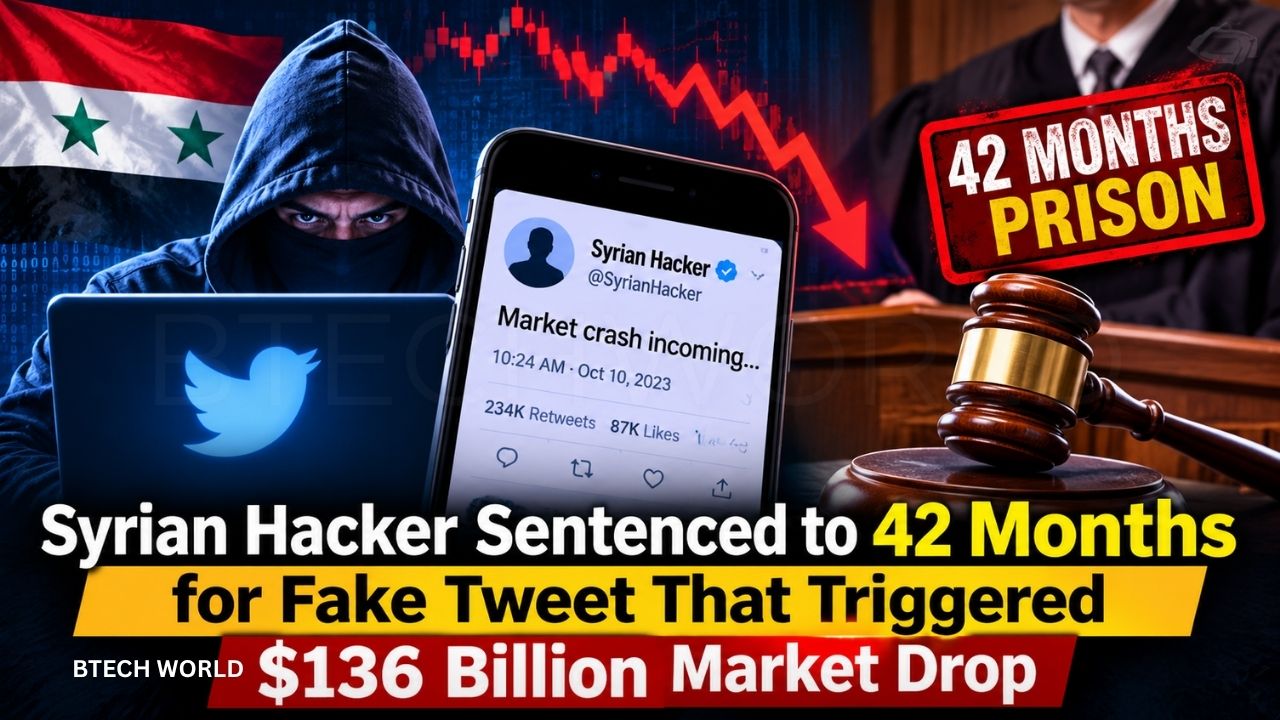
Syrian Hacker Sentenced to 42 Months for Fake Tweet That Triggered $136 Billion Market Drop

A Syrian hacker has been sentenced to 42 months in a U.S. federal prison for his role in a major cybercrime conspiracy that targeted Western media organizations, businesses, nonprofit groups, and government entities. Ahmad Umar Agha, also known online as Th3Pr0, was involved in a campaign linked by the U.S. Department of Justice to the former government of Syrian President Bashar al-Assad.
One of the most widely reported incidents involved the hijacking of the Associated Press’s Twitter account in April 2013. The attackers published a fake message claiming that explosions had occurred at the White House and that President Barack Obama had been injured. The false report caused a brief disturbance in financial markets. The Justice Department says the incident temporarily erased approximately $136 billion from the value of stocks in the Dow Jones Industrial Average.
The sentence, announced on October 29, 2026, brings renewed attention to the risks of compromised social media accounts, coordinated cyber operations, and online misinformation.
Who Is Ahmad Umar Agha?
Ahmad Umar Agha is a Syrian national who used the online alias Th3Pr0. U.S. authorities identified him as a central participant in a hacking conspiracy associated with the Syrian Electronic Army. The group carried out cyberattacks against organizations that reported on the Syrian government or were considered opponents of its interests.
According to the Justice Department, the broader conspiracy operated from at least August 2011 through January 2024. Its activities included stealing account credentials, compromising websites, redirecting online visitors, and accessing social media accounts. Authorities said the campaign targeted approximately 47 Western media outlets, businesses, nonprofit organizations, and U.S. and allied government entities.
Agha’s activities went beyond website defacement or ordinary account hacking. Investigators linked the campaign to propaganda, intelligence gathering, intimidation, and attempts to influence public opinion. The case demonstrates how cyberattacks can serve political objectives while creating consequences for organizations and ordinary internet users.
Why Was the Syrian Hacker Sentenced to 42 Months?
A federal court in the Eastern District of Virginia sentenced Agha to 42 months in prison for his central role in the hacking conspiracy. The Justice Department described the operation as organized and led by members of former Syrian President Bashar al-Assad’s inner circle, including the commander of Syria’s General Intelligence Directorate.
Prosecutors said the conspiracy used hacking to discourage negative reporting about the former Syrian government, intimidate its opponents, and gather information. It also attempted to influence members of the U.S. military through online propaganda.
The sentence reflects the seriousness of a campaign that affected multiple sectors and involved targets outside Syria. The case also highlights the challenges law enforcement agencies face when investigating cybercrime that crosses national borders and involves several participants.
The Fake Tweet That Triggered a Market Shock
The most famous incident connected to Agha occurred on April 23, 2013. Hackers gained control of the Associated Press’s Twitter account and published a false report claiming that two explosions had taken place at the White House and President Obama had been injured.
Because the message appeared on a trusted news organization’s account, it quickly attracted attention. Investors and financial market participants reacted before the report could be confirmed as false. The resulting uncertainty contributed to a brief market disruption.
The Justice Department attributed a temporary $136 billion loss in the value of Dow Jones Industrial Average stocks to Agha’s actions. This figure describes a temporary change in market value, not $136 billion in confirmed permanent financial losses. Markets recovered after the false report was corrected.
The incident became a prominent example of how quickly misinformation can affect financial markets when it appears to come from a trusted source.
How Did Hackers Gain Access to the Associated Press Account?
The incident involved unauthorized access to the Associated Press’s Twitter account. Investigative records cited in earlier reporting connected the account’s password-reset process to an email address primarily used by Agha.
The broader hacking campaign relied on techniques such as phishing and stolen credentials. Attackers could send deceptive messages to employees, obtain login information, and use those details to access organizational systems. Once inside an account, they could publish false information or use the compromised access to reach other services.
This approach shows why social media security depends on more than choosing a strong password. Organizations must also protect employee email accounts, secure account recovery processes, restrict administrative access, and monitor unusual login activity.
The Syrian Electronic Army’s Wider Cyber Campaign
The Syrian Electronic Army became known for online operations supporting the former Assad government. Its activities included attacks against media organizations, businesses, and other groups. The campaign used compromised accounts and websites to spread political messages and interfere with the work of targeted organizations.
The Justice Department says Agha and his co-conspirators hacked approximately 47 Western targets. These included news organizations, companies, nonprofit groups, and government-related entities. The objective was not limited to disrupting websites. Authorities said the campaign also sought to collect intelligence and discourage criticism of the former Syrian government.
The attacks illustrate how politically motivated hacking can combine technical intrusion with information warfare. A compromised account can spread propaganda, while access to internal systems can expose sensitive information and disrupt an organization’s operations.
Attack on the U.S. Marine Corps Recruitment Website
Another significant incident involved the company hosting the U.S. Marine Corps recruitment website. According to the Justice Department, Agha gained access to the hosting company and redirected website visitors to a page displaying a political message.
The image encouraged U.S. Marines to refuse their orders and fight alongside the Syrian Army. Authorities said approximately 3,500 potential visitors saw the message instead of the intended recruitment content.
This attack demonstrated how compromising a third-party service can affect an organization that does not directly control the breached infrastructure. The attackers did not need to take over the Marine Corps website itself if they could manipulate the company responsible for hosting it.
The incident also showed how website redirects can turn an ordinary browsing experience into a tool for political messaging.
Financial and Operational Damage to Victims
The hacking campaign created costs beyond temporary website outages or misleading social media posts. Organizations had to investigate incidents, restore affected systems, strengthen security, and train employees.
The Justice Department reported that one global nonprofit organization suffered approximately $480,000 in losses. That amount included around $250,000 for new network monitoring products. The organization also retrained more than 800 staff members and upgraded its security systems.
Another company that supplied content, advertisements, and links to online publishers reportedly lost approximately $35,000 per day for around six months.
These figures show how a cyberattack can create long-term financial pressure. Even after attackers lose access, victims may need months of technical work and additional spending to restore trust and prevent further intrusions.
Attempts to Access White House Social Media Accounts
The Justice Department also described attempts to compromise White House social media accounts. The conspiracy targeted staff email credentials in an effort to gain access to accounts used for official communications.
In one instance, attackers obtained access to a staff member’s email account. They then attempted to use that access to persuade other employees to provide information that could help compromise additional accounts. The effort did not result in control of the official White House social media accounts.
This part of the case highlights the risks of targeting employees rather than attacking a public-facing account directly. A single compromised mailbox can provide attackers with information about internal communications, account recovery procedures, and other employees.
What the Case Teaches About Social Media Security
The fake Associated Press tweet demonstrates why organizations must treat social media accounts as important business assets. A verified or widely recognized account can influence public opinion, financial decisions, and the reputation of an institution.
Organizations should use multi-factor authentication, unique passwords, and dedicated account-management procedures. Access should be limited to employees who genuinely need it. Companies should also review account recovery settings and remove access when staff members change roles or leave.
Monitoring is equally important. Unexpected password-reset messages, unfamiliar login locations, and unusual publishing activity can indicate an account compromise. Organizations should have a clear process for verifying urgent posts before sharing information that could affect public safety or financial markets.
What Happens Next in the Case?
Agha’s 42-month sentence marks a major development in a case that began more than a decade ago. U.S. authorities had pursued the investigation for years, and the defendant had spent more than a decade as a fugitive, according to the Justice Department.
The department also identified Firas Dardar as a co-conspirator who remains a fugitive. The wider investigation included other individuals connected to hacking activities, including a Syrian national who was extradited to the United States and pleaded guilty in a separate case in 2016.
The sentencing sends a message that cybercriminals can face prosecution even when attacks take place across international borders. However, cases involving multiple suspects and overseas operations can take years to investigate and resolve.
Why This Cybercrime Case Matters
The case is important because it connects several major cybersecurity concerns: account hijacking, phishing, political propaganda, website compromise, and financial misinformation. It also shows that a single false social media post can create consequences far beyond the platform where it appears.
For businesses, the lesson is to protect digital accounts and third-party services with the same care given to internal networks. For news organizations, account security is closely connected to editorial credibility. For investors and the public, the incident is a reminder to verify extraordinary breaking news before reacting to it.
The 42-month sentence also highlights the growing role of international law enforcement in investigating politically motivated cybercrime.
Conclusion
Ahmad Umar Agha, the Syrian hacker known as Th3Pr0, has received a 42-month prison sentence for his role in a wide-ranging hacking conspiracy linked by U.S. authorities to the former Assad government. The campaign targeted around 47 organizations and included the 2013 hijacking of the Associated Press’s Twitter account.
The fake White House explosion report caused a brief financial market shock, with the Justice Department attributing a temporary $136 billion drop in stock value to the incident. Other attacks affected nonprofit organizations, businesses, and government-related websites.
The case demonstrates that cyberattacks can create serious political, financial, and reputational consequences. It also reinforces the importance of strong account security, employee awareness, and rapid verification of breaking information.
FAQs
Who is the Syrian hacker sentenced to 42 months in prison?
The hacker is Ahmad Umar Agha, also known by the online alias Th3Pr0. U.S. authorities identified him as a central participant in a hacking conspiracy associated with the Syrian Electronic Army.
Why was Ahmad Umar Agha sentenced?
Agha was sentenced for his role in a wide-ranging hacking conspiracy that targeted Western media organizations, businesses, nonprofit groups, and government entities. Authorities linked the campaign to propaganda, intelligence gathering, and intimidation.
How did the fake tweet affect the stock market?
Hackers hijacked the Associated Press’s Twitter account on April 23, 2013, and published a false report claiming President Barack Obama had been injured in explosions at the White House. The Justice Department says the incident caused a temporary $136 billion drop in the value of Dow Jones Industrial Average stocks.
What was the Syrian Electronic Army?
The Syrian Electronic Army was a hacking group known for cyberattacks supporting the former Syrian government. Its activities included compromising social media accounts, defacing websites, redirecting visitors, and targeting organizations critical of the regime.
What can businesses learn from this cyberattack?
Businesses should protect social media and email accounts with multi-factor authentication, strong access controls, secure recovery procedures, and regular monitoring. They should also train employees to recognize phishing attempts and verify unusual requests before acting on them.
Explore More BTECH WORLD