What Are Software Supply Chain Attacks? How They Work and How to Prevent Them

Software supply chain attacks are cybersecurity threats that target the tools, services, code libraries, and development processes used to build and distribute software. Instead of attacking a company’s systems directly, cybercriminals compromise a trusted component or supplier and use that access to reach other organizations. These attacks can affect developers, software vendors, businesses, and everyday users who rely on digital applications.
As modern software depends on open-source packages, third-party services, automated build systems, and external updates, the number of potential entry points continues to grow. A single compromised dependency can introduce malicious code into thousands of projects. Understanding how software supply chain attacks work is essential for organizations that want to protect their applications, customer data, and development environments.
What Is a Software Supply Chain Attack?
A software supply chain attack occurs when an attacker compromises a component or process involved in developing, building, distributing, or maintaining software. The attacker then uses that compromise to introduce malicious code, steal information, gain unauthorized access, or affect downstream users.
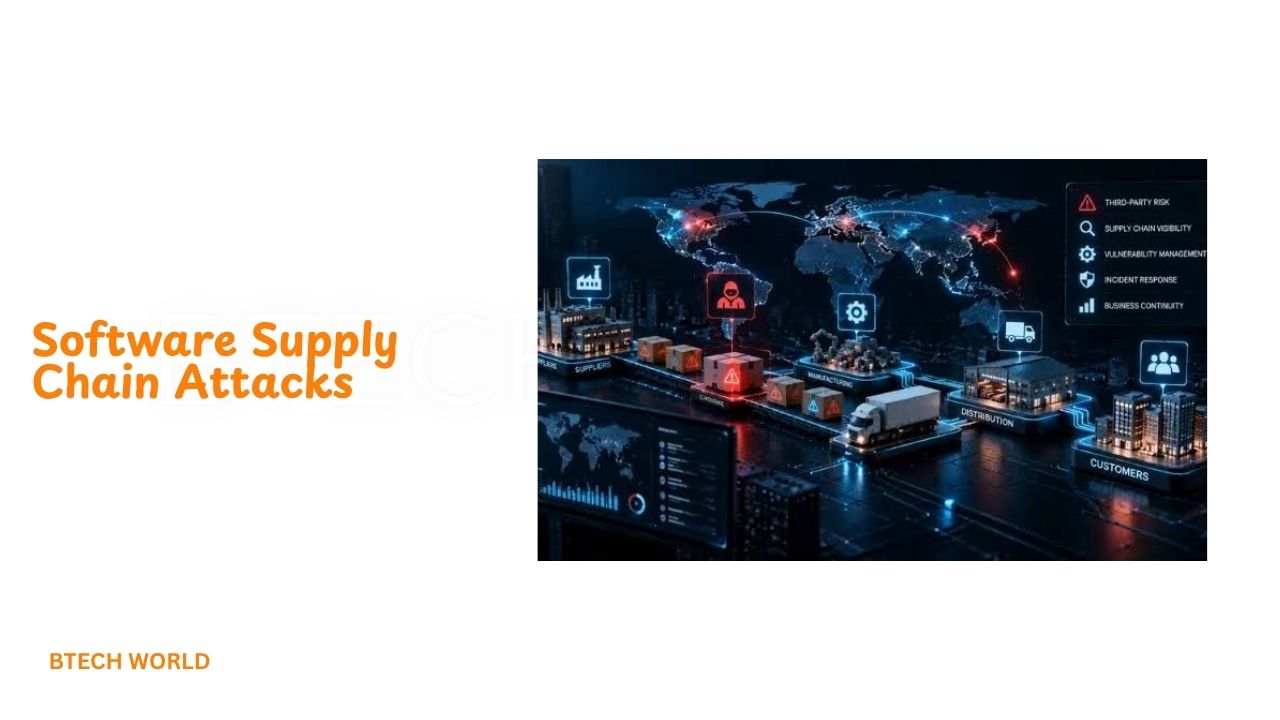
Software supply chains include much more than the final application. They can involve source code repositories, package managers, open-source libraries, development tools, cloud infrastructure, code-signing systems, and software update services. Weaknesses in any of these areas can create opportunities for attackers.
For example, a development team might install a legitimate-looking package that has been modified to steal environment variables or authentication credentials. If the package becomes part of a production application, the malicious behavior may reach customers as well. The organization may trust the package because it comes from a familiar ecosystem, making the compromise difficult to recognize.
How Do Software Supply Chain Attacks Work?
1. Identifying a Weak Link
Attackers begin by searching for a vulnerable or poorly protected part of the software development process. They may target an open-source maintainer, a software vendor, a package repository, a developer account, or a continuous integration system.
Small projects can be attractive targets because they may have limited security resources. However, widely used libraries and trusted software providers can offer a much larger potential impact. Attackers often look for a route that allows one compromise to affect multiple organizations.
2. Compromising a Trusted Component
After identifying a target, attackers attempt to gain unauthorized access or manipulate a software component. They may steal developer credentials, exploit an unpatched system, compromise a maintainer account, or publish a malicious package that imitates a legitimate one.
In some cases, attackers modify source code or inject malicious instructions into an automated build process. The resulting software may appear normal because the malicious behavior is hidden within an otherwise useful component.
3. Distributing the Malicious Code
The compromised component may then reach developers or customers through a normal distribution channel. For example, an application may automatically download an affected dependency during a build, or an organization may install a compromised software update.
This distribution stage makes supply chain attacks particularly dangerous. Security teams may trust the delivery mechanism because it belongs to an established vendor or package repository. However, a trusted distribution channel does not guarantee that every component passing through it is safe.
4. Activating the Attack
Once the compromised software runs, it may perform actions such as collecting credentials, accessing sensitive files, opening unauthorized communication channels, or modifying application behavior. The exact impact depends on the malicious code and the permissions available to it.
Some attacks operate immediately, while others remain dormant until specific conditions are met. Attackers may attempt to avoid detection by limiting their activity or disguising it as normal software behavior.
5. Expanding the Impact
A successful compromise can spread beyond the original target. A malicious library included in several products may affect multiple customers, while stolen developer credentials may provide access to additional repositories or cloud systems.
Organizations must therefore investigate not only the compromised component but also the systems, builds, accounts, and applications that interacted with it.
Common Types of Software Supply Chain Attacks
Open-Source Dependency Attacks
Modern applications often depend on third-party libraries that provide common functions. Attackers may compromise an existing package, take over a maintainer account, or publish a malicious package with a name similar to a legitimate dependency.
Developers can reduce these risks by checking package ownership, reviewing dependency changes, using trusted registries, and monitoring security advisories. Automated dependency scanning can also identify known vulnerabilities, although it may not detect every newly introduced malicious package.
Build System and CI/CD Attacks
Continuous integration and continuous delivery systems automate activities such as testing, compiling, packaging, and deploying software. Because these systems often have access to source code, signing credentials, and deployment environments, they can be valuable targets.
If attackers compromise a build runner, pipeline configuration, or automation token, they may manipulate the output without directly changing the source code developers review. Strong access controls, isolated build environments, protected pipeline settings, and secure handling of secrets help reduce this risk.
Software Update Attacks
Software updates are intended to deliver fixes and improvements, but attackers may abuse the update process if they compromise a vendor or distribution system. A malicious update can then reach users through an otherwise legitimate installation mechanism.
Organizations should verify update authenticity, use supported software versions, monitor vendor security announcements, and maintain procedures for responding to compromised releases. Digital signatures and secure update infrastructure provide important protections when implemented and managed correctly.
Developer Account Compromise
Developer accounts can provide access to source repositories, package registries, and software publishing workflows. Attackers may target these accounts through phishing, stolen passwords, leaked tokens, or compromised devices.
Multi-factor authentication, short-lived credentials where supported, least-privilege permissions, and regular access reviews can make account compromise harder to exploit. Organizations should also revoke exposed credentials promptly and investigate suspicious repository or publishing activity.
Third-Party Vendor Compromise
Businesses often rely on external providers for development tools, analytics, cloud services, and software components. If one provider is compromised, attackers may use its legitimate access or products to reach customers.
Vendor risk assessments, security requirements in contracts, incident notification procedures, and ongoing monitoring can help organizations understand and manage these dependencies. Trust in a supplier should be supported by evidence and appropriate controls.
Real-World Examples of Software Supply Chain Attacks
Several well-known incidents demonstrate how compromises can spread through trusted software channels.
SolarWinds Orion
The SolarWinds incident, publicly disclosed in December 2020, involved attackers compromising the software build and distribution process for Orion products. Malicious code was inserted into software updates, which were then distributed to customers.
The incident showed how a compromise at one software provider can affect many downstream organizations. It also highlighted the importance of securing build environments, monitoring software updates, and investigating unusual behavior even when software comes from a trusted source.
Codecov
In April 2021, Codecov disclosed a security incident involving its Bash Uploader. Attackers had modified the uploader, potentially exposing credentials and other sensitive information from customer environments where it was used.
The incident demonstrated that development tools and automation scripts can become supply chain risks. Organizations need to verify third-party tools, protect environment variables, and limit the credentials available to build processes.
The XZ Utils Backdoor Attempt
In 2024, a malicious backdoor was discovered in certain versions of XZ Utils, a data compression utility used by many Linux-based systems. The attempt involved a long-running effort associated with gaining trust within the project’s maintainer community.
The discovery illustrated how open-source projects can face sophisticated attacks against their people and release processes. It also showed the value of careful code review, investigation of unusual behavior, and cooperation between researchers and maintainers.
Why Software Supply Chain Attacks Are Dangerous
One Compromise Can Affect Many Organizations
A vulnerability in an individual application may have a limited scope. However, a compromised dependency or update mechanism can reach many organizations that rely on the same component. This creates a multiplier effect that makes supply chain incidents difficult to contain.
The impact depends on how widely the component is used, what permissions it receives, and whether the malicious behavior is detected before deployment.
Malicious Code Can Look Legitimate
Supply chain attacks often exploit trust. The compromised component may have a valid version number, come from a familiar repository, or be delivered through a legitimate vendor’s infrastructure.
Traditional defenses may not immediately identify the threat because the software appears to follow expected installation or update procedures. Organizations need controls that examine provenance, behavior, integrity, and access patterns rather than relying solely on reputation.
Recovery Can Be Complex
After a supply chain compromise, organizations must identify affected versions, determine which systems installed them, investigate possible credential exposure, and rebuild compromised environments where necessary.
They may also need to coordinate with vendors, notify affected customers, rotate secrets, and review deployment logs. Without an accurate inventory of software components and dependencies, it can be difficult to establish the full scope of an incident.
How to Prevent Software Supply Chain Attacks
Maintain a Software Bill of Materials
A software bill of materials, commonly called an SBOM, is an inventory of components included in a software product. It can identify direct and indirect dependencies, helping organizations understand which libraries and packages their applications use.
When a vulnerability or malicious component is discovered, an SBOM can make it easier to identify potentially affected applications. However, an SBOM is not a security guarantee. Its value depends on accuracy, completeness, and regular updates.
Organizations should generate and maintain component inventories as part of their build and release processes. They should also establish procedures for reviewing affected components and updating software when risks emerge.
Use Dependency Scanning and Verification
Dependency scanning tools help identify known vulnerabilities in third-party packages. Some tools also detect suspicious package versions, license issues, and other risks. Developers should use maintained dependencies and review changes before introducing new components.
Package lockfiles can help ensure that builds use expected dependency versions. Where supported, package integrity checks, trusted registries, and cryptographic verification can provide additional safeguards.
Scanning alone is not enough because a newly published malicious package may not yet have a known vulnerability record. Teams should combine automated tools with sensible dependency selection and review procedures.
Secure Source Code Repositories
Source repositories should enforce strong authentication and limit access according to each user’s responsibilities. Multi-factor authentication, protected branches, mandatory reviews, and restrictions on release permissions can reduce opportunities for unauthorized changes.
Organizations should monitor unusual commits, unexpected changes to workflow files, and modifications to package publishing settings. Repository secrets must be protected, and exposed tokens should be revoked immediately.
Regular access reviews also help remove unnecessary permissions when employees change roles or leave an organization.
Protect Build and Deployment Pipelines
Build systems should receive only the permissions required for their assigned tasks. Avoid giving every workflow unrestricted access to production infrastructure or long-lived credentials.
Organizations can use isolated build environments, short-lived credentials, protected deployment approvals, and controlled release processes. They should also review third-party actions and reusable workflows before allowing them to execute in sensitive environments.
Where practical, reproducible builds and signed artifacts can help teams verify that software was produced through an expected process. These controls improve confidence in the release pipeline but still require careful implementation and monitoring.
Monitor Software and Vendor Risks
Continuous monitoring helps organizations identify suspicious changes and respond before problems spread. Teams should watch security advisories, dependency alerts, repository activity, and vendor incident announcements.
For critical suppliers, organizations should understand how quickly a vendor communicates incidents and provides fixes. Security reviews should consider the supplier’s access to sensitive systems, the importance of its software, and the consequences of a potential compromise.
Monitoring should lead to action. Organizations need clear procedures for isolating affected systems, disabling compromised integrations, replacing unsafe components, and communicating with relevant stakeholders.
The Role of DevSecOps in Supply Chain Security
DevSecOps integrates security practices into software development, testing, and deployment. Instead of waiting until an application is complete, teams include security checks throughout the development lifecycle.
These checks can include static code analysis, dependency scanning, secret detection, container image scanning, and verification of release artifacts. Automated controls provide quick feedback, while security specialists investigate higher-risk findings and improve the overall process.
Successful DevSecOps requires cooperation between developers, security teams, and operations staff. Security controls should be practical enough to support everyday work while preventing avoidable risks. Regular reviews help organizations adapt as their technology stacks and threat environments change.
Conclusion
Software supply chain attacks exploit the trust that connects developers, vendors, dependencies, build systems, and software users. By compromising a single component or distribution process, attackers may gain opportunities to affect many organizations at once.
Preventing these attacks requires a layered approach. Businesses should maintain software inventories, verify dependencies, secure developer accounts, protect build pipelines, and monitor third-party risks. They should also prepare incident response procedures that help them identify affected systems and contain compromises quickly.
No single tool can eliminate every supply chain threat. However, combining secure development practices, strong access controls, continuous monitoring, and reliable software provenance can significantly improve an organization’s ability to detect and manage these risks.
Frequently Asked Questions
1. What is a software supply chain attack?
A software supply chain attack occurs when attackers compromise a software component, supplier, development tool, or distribution process to introduce malicious code or gain unauthorized access to downstream systems.
2. What are common examples of software supply chain attacks?
Examples include compromised open-source packages, malicious software updates, stolen developer credentials, tampered build pipelines, and attacks on third-party vendors. SolarWinds Orion, Codecov, and the XZ Utils backdoor attempt illustrate different supply chain risks.
3. How can developers prevent software supply chain attacks?
Developers can review dependencies, use trusted package sources, scan for vulnerabilities, protect repository credentials, require code reviews, and secure automated build and deployment pipelines.
4. What is an SBOM, and why is it important?
An SBOM is a software bill of materials that lists the components used in a software product. It helps organizations identify affected dependencies when a vulnerability or malicious package is discovered.
5. Are open-source libraries safe to use?
Open-source libraries can be valuable and widely reviewed, but they are not automatically safe. Developers should evaluate maintenance activity, use appropriate security checks, verify package sources, and update vulnerable components when necessary.
Explore More BTECH WORLD