
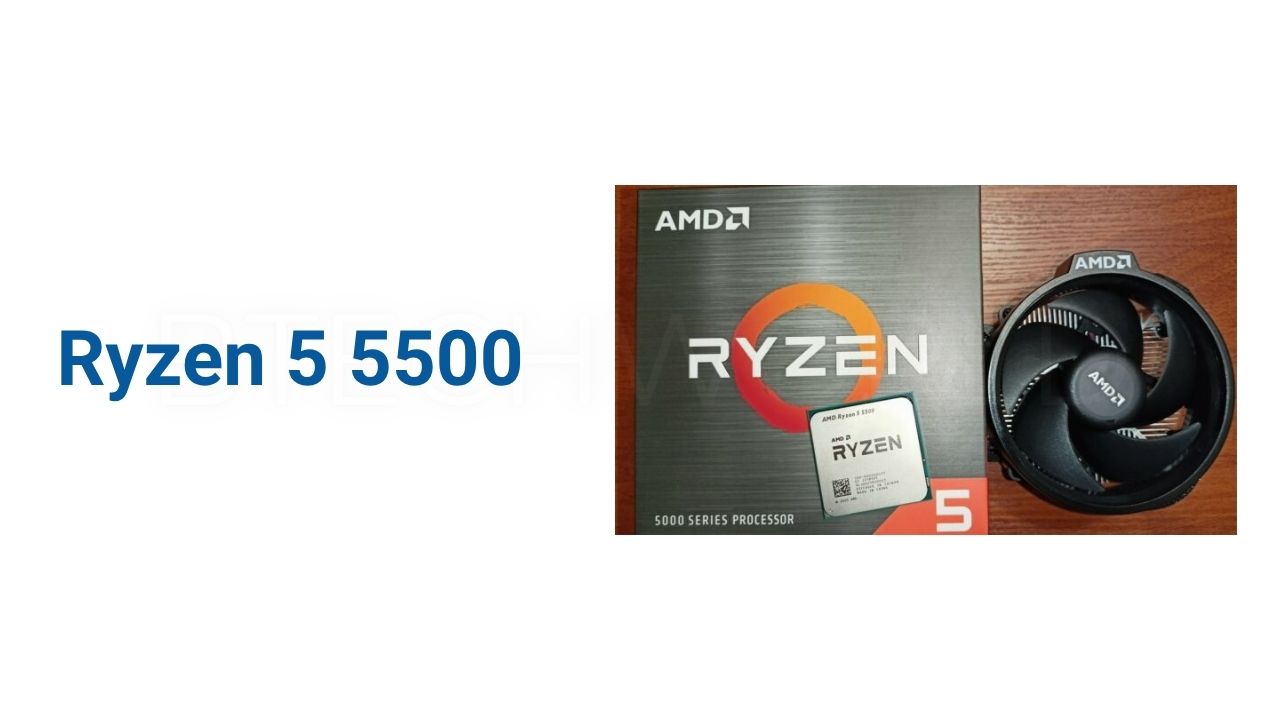
Ryzen 5 5500 for Gaming: Features, Performance, and Compatibility

The Ryzen 5 5500 for Gaming remains an interesting option for budget PC builders who want six CPU cores without spending heavily on a processor. AMD launched the Ryzen 5 5500 as part of its Zen 3 lineup, giving it six cores, 12 threads, a 3.6 GHz base clock, and up to 4.2 GHz boost speed. It also uses the AM4 platform and supports DDR4 memory.
For gaming, the processor can deliver good results when paired with a suitable graphics card. It can handle popular 1080p gaming workloads, esports titles, everyday applications, and multitasking. However, its older PCIe 3.0 interface and smaller 16MB L3 cache make it less attractive than some newer processors.
What Is the Ryzen 5 5500?
The Ryzen 5 5500 is a six-core, 12-thread desktop processor based on AMD’s Zen 3 architecture. It belongs to the Ryzen 5000 family and uses the AM4 socket. Its 65W thermal design power also makes it suitable for relatively affordable gaming systems.
One important detail is that the Ryzen 5 5500 does not include integrated graphics. AMD lists a discrete graphics card as required, so users cannot connect a monitor directly to the processor.
This design makes sense for gaming PCs because most gaming systems already use a dedicated GPU. The money saved on the CPU can instead go toward a better graphics card, faster storage, or additional memory.
These specifications show why the Ryzen 5 5500 targets budget and mid-range systems. Six cores and 12 threads give it enough processing capacity for gaming while also providing useful performance for background applications.
Gaming Performance of Ryzen 5 5500
Gaming performance depends heavily on the graphics card, resolution, game settings, and memory configuration. Still, the Ryzen 5 5500 can provide solid 1080p performance when matched with an appropriate GPU.
Tom’s Hardware tested the Ryzen 5 5500 against several competing processors using a powerful RTX 3090 to minimize GPU limitations. In its 1080p gaming test suite, the Ryzen 5 5500 delivered solid results, although competing Intel processors performed better in that particular comparison.
This means the processor is capable of gaming, but it is not designed to compete with today’s high-end gaming CPUs. With a budget graphics card, the difference between processors may also become less noticeable because the GPU becomes the main performance limit.
1080p Gaming
The Ryzen 5 5500 makes the most sense for 1080p gaming. A balanced GPU can allow the processor to deliver good frame rates across many games.
Competitive titles such as esports games can benefit from its six cores and 12 threads. Games that rely heavily on CPU performance may expose the processor’s limitations sooner, especially when paired with a powerful graphics card and a high-refresh-rate monitor.
For standard 60Hz or 75Hz gaming, however, the Ryzen 5 5500 can still be a practical choice when its price is low.
Is Ryzen 5 5500 Good for Modern Games?
Yes, but expectations matter. The Ryzen 5 5500 is not a premium gaming processor. It is better viewed as a value-focused CPU for affordable gaming computers.
Modern games can use multiple CPU threads, and the 5500’s six cores and 12 threads give it useful headroom. It can also manage background applications while a game is running.
The main limitation appears when users combine the CPU with a very powerful GPU and target extremely high frame rates. In those situations, a faster processor with more cache can provide better minimum frame rates and overall consistency.
Ryzen 5 5500 and Graphics Cards
Choosing the right GPU is important because the Ryzen 5 5500 requires a dedicated graphics card. AMD’s official specifications confirm that the processor has no integrated graphics.
For a budget build, pairing it with a mainstream graphics card can create a sensible balance. The CPU does not need an expensive high-end GPU to provide a good gaming experience.
However, pairing the Ryzen 5 5500 with a very powerful modern GPU can create a CPU limitation in some games, especially at 1080p. At higher resolutions, the GPU usually becomes more important, which can reduce the practical impact of CPU differences.
Ryzen 5 5500 and RAM Compatibility
The Ryzen 5 5500 supports DDR4 memory, with DDR4-3200 listed among its supported specifications.
A gaming system should ideally use two memory modules rather than relying on a single stick. Dual-channel memory can help the processor communicate with system memory more effectively.
For a budget gaming PC, 16GB of DDR4 remains a sensible starting point. Users who stream games, edit videos, run multiple applications, or use demanding software may benefit from more memory.
AM4 Compatibility
One of the biggest advantages of the Ryzen 5 5500 is its AM4 platform. Users who already own a compatible AM4 motherboard may be able to upgrade their processor without replacing the entire platform.
AMD expanded Ryzen 5000 support to additional older motherboards through BIOS updates, although compatibility depends on the specific motherboard manufacturer and BIOS version.
Before buying, users should check their motherboard’s CPU support list and BIOS requirements. This is especially important with older 300-series and 400-series boards.
PCIe 3.0: What Does It Mean for Gaming?
The Ryzen 5 5500 supports PCIe 3.0 rather than PCIe 4.0.
For many budget gaming configurations, this is not a major problem. A typical graphics card can still provide excellent gaming performance over PCIe 3.0.
However, PCIe 3.0 does make the Ryzen 5 5500 less future-oriented than newer processors. Users planning a modern high-end system may prefer a platform with newer connectivity.
For someone upgrading an existing AM4 computer, though, PCIe 3.0 can be an acceptable compromise.
Ryzen 5 5500 vs Ryzen 5 5600
The Ryzen 5 5600 is one of the most important alternatives to consider. Both processors feature six cores and 12 threads, but the Ryzen 5 5600 has higher clock speeds and 32MB of L3 cache compared with the 5500’s 16MB.
That larger cache can help the Ryzen 5 5600 deliver stronger gaming performance. Tom’s Hardware’s testing also showed a meaningful performance gap between the two processors.
If the price difference is small, the Ryzen 5 5600 can be the better long-term choice. If the Ryzen 5 5500 is significantly cheaper, it can still make sense for a budget-focused build.
Cooling and Power Requirements
The Ryzen 5 5500 has a 65W TDP and was sold with AMD’s Wraith Stealth cooler.
The included cooler can make the processor attractive for low-cost PC builds because buyers do not necessarily need to purchase a separate CPU cooler.
A stronger aftermarket cooler can still be useful for users who want lower temperatures, reduced fan noise, or additional thermal headroom. The processor is also unlocked for overclocking, although overclocking results depend on the individual chip, motherboard, cooling, and settings.
Is Ryzen 5 5500 Worth Buying for Gaming?
The answer depends on the price and the rest of the PC.
For someone upgrading an existing AM4 system, the Ryzen 5 5500 can be an affordable way to move to six Zen 3 cores and 12 threads. It can also work well in a budget gaming build where every dollar matters.
For a brand-new PC, buyers should compare its current price with newer processors before making a decision. The Ryzen 5 5500’s PCIe 3.0 limitation and smaller cache reduce its appeal compared with stronger modern options.
Still, a low purchase price can make the processor attractive for 1080p gaming.
Best Use Cases for Ryzen 5 5500
The Ryzen 5 5500 is best suited to several types of users:
- Budget gaming PC builders
- Existing AM4 motherboard owners
- 1080p gamers
- Esports players
- Users who need six cores and 12 threads
- Affordable home and productivity computers
- Builds using a mainstream dedicated graphics card
It is less suitable for premium gaming systems designed around high-end GPUs and very high refresh rates.
Final Verdict
The Ryzen 5 5500 for Gaming offers a practical combination of six cores, 12 threads, Zen 3 architecture, and AM4 compatibility. Its 4.2 GHz maximum boost clock and 65W power rating make it a capable budget processor.
Its biggest weaknesses are the lack of integrated graphics, PCIe 3.0 support, and smaller 16MB L3 cache. These limitations do not make it a bad gaming CPU, but they matter when comparing it with newer alternatives.
For an affordable 1080p gaming PC or an AM4 upgrade, the Ryzen 5 5500 can still be a sensible choice when the price is right. Buyers building a completely new PC should compare it carefully with the Ryzen 5 5600 and newer platforms before purchasing.
Frequently Asked Questions
Is Ryzen 5 5500 good for gaming?
Yes. Its six cores and 12 threads make it capable of handling 1080p gaming with a suitable dedicated graphics card.
Does Ryzen 5 5500 have integrated graphics?
No. AMD specifies that a discrete graphics card is required with the Ryzen 5 5500.
What GPU should I use with Ryzen 5 5500?
A mainstream graphics card is generally a good match. The ideal GPU depends on your resolution, games, settings, and budget.
Does Ryzen 5 5500 support PCIe 4.0?
No. The Ryzen 5 5500 is limited to PCIe 3.0.
Is Ryzen 5 5500 better than Ryzen 5 5600?
The Ryzen 5 5600 is generally faster because it has higher clocks and twice the L3 cache. The 5500 becomes more attractive when it is substantially cheaper.
Explore More: BTECH WORLD